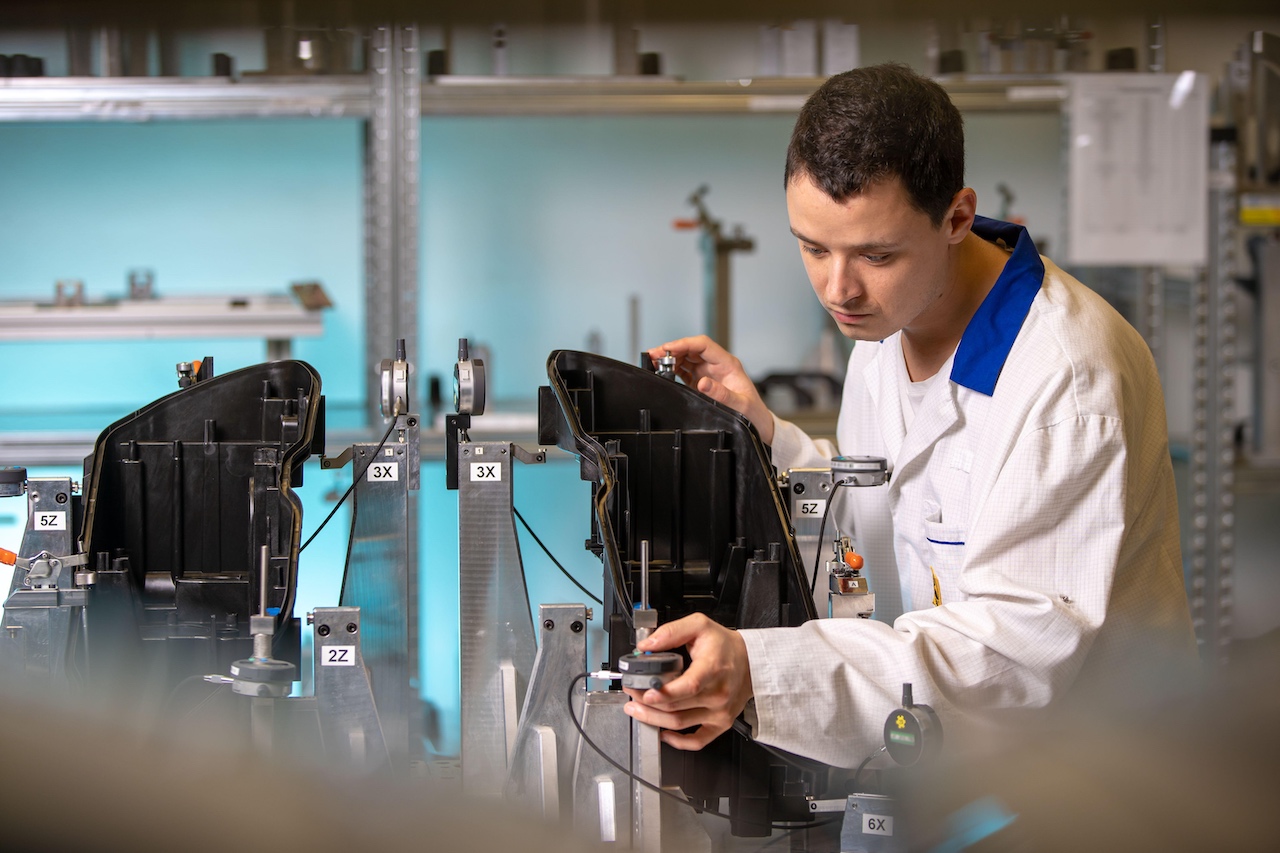
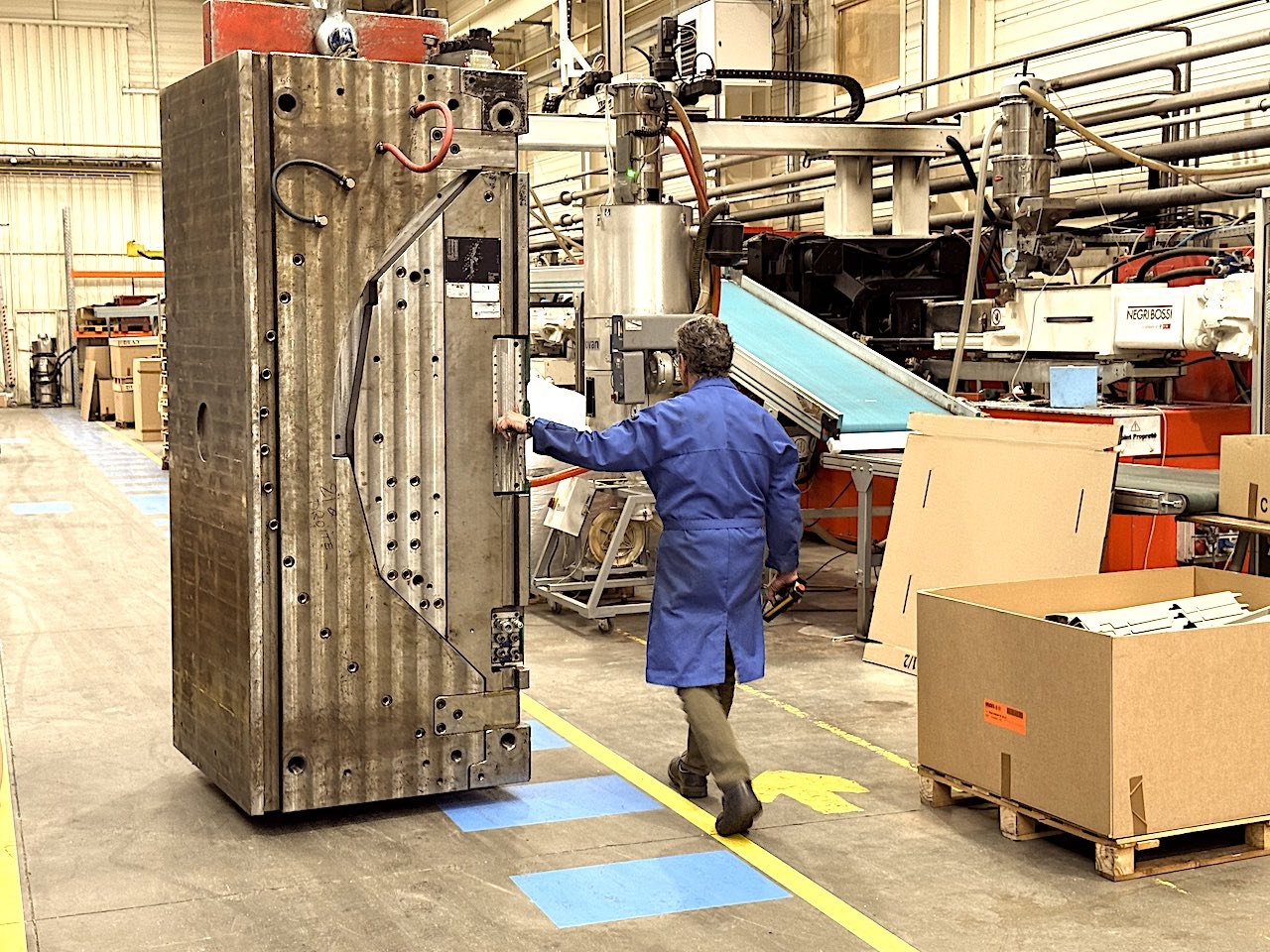
BENOIT AMOUYAL, TOOLING MANAGER, MOULD ADJUSTER
EDELTAMP that its performance as a high-quality injection molding machine manufacturer is not only measured by the speed of its presses, but above all by one key factor: the quality of its molds...

The injection mold, a true strategic asset
Plastics manufacturer specializing in the molding and machining of thermoplastic parts, EDELTAMP brings together experts in the design, development, and production of technical parts and semi-finished products for all types of industries.
Benoît Amouyal, Tooling Manager and Mold Maker, is responsible for molds. His expertise ensures not only the manufacture and maintenance of molds, but also the long-term preservation of customers' industrial and financial capital.
When do you intervene as a Tooling Manager/Mold Maker?
At EDELTAMP, I am involved in all stages of production: before, during, and after. My main task is preventive and corrective maintenance of molds, but my role begins well before the first part comes out of the press.
Upstream, depending on where the mold comes from, I carry out a complete overhaul: checking the impressions, thorough cleaning, checking the water and oil circuits, and inspecting the auxiliary equipment. I examine the surfaces, detect any defects, and polish if necessary. The goal is simple: to deliver the part expected by the customer, in accordance with the specifications, while preserving the integrity of the mold.
During the series, I remain vigilant. Any variation in appearance, minor touch-ups or adjustments are dealt with immediately. At the end of production, the mold is systematically returned to the workshop for a complete inspection: wear and tear, emerging defects, friction points... nothing is left to chance.
This vigilance ensures a clear objective: to place each mold in a controlled and sustainable life cycle, maintaining its properties unchanged throughout its operational life.
What expertise is required for this job?
Benoît Amouyal 's career path sheds light on his practice. Trained in mechanical production engineering, he started out in mold manufacturing. He is familiar not only with the finished tool, but also with the raw material.
"I have expertise in steel blocks. I know how they are machined, how the water circuits are integrated, and how the cooling system works."
This knowledge of metals, their thermal conductivity, and heat flows allows me to anticipate how the mold will behave during production. I don't see an isolated part; I understand the entire system. This technical expertise feeds into a preventive approach: understanding in order to avoid problems.
What critical issues do you challenge to ensure reliability in series production?
"Reliability is built right from the design stage. For me, the most important factors are the quality of the steel and the intelligent operation of the mold."
The choice of material determines wear resistance, thermal stability, and longevity. Depending on the aesthetic or technical requirements of the part, I examine the mirror polish, grain, and finish of the impressions. The thermodynamics of flows also come into play: heat distribution, cooling efficiency, material filling via hot blocks, etc.
These parameters are not mere details. They determine the future robustness of the mold. By intervening at this stage, Benoît Amouyal playsa key preventive role: securing the tooling upstream and limiting subsequent corrective interventions.
What distinguishes a "functional" mold from an "industrially reliable" mold?
"A basic mold has little cooling and few peripherals. A reliable mold, on the other hand, is designed from the outset so that wear areas can be easily replaced, thermal regulation can be precisely adjusted, and maintenance can be carried out more easily, directly on the press."
The distinction is therefore fundamental. A functional mold produces compliant parts. An industrially reliable mold produces compliant parts on a long-term basis.
The modularity of the inserts, the presence of high-performance hot blocks, the density of the cooling circuits, the possibility of replacing certain parts without dismantling the entire unit: all these elements reflect an engineering approach focused on durability. Robustness is not an added extra; it is an industrial strategy.
When receiving a new mold, what checks are crucial?
"Between theory and industrial reality, there is one decisive step: pre-production. We produce between one hundred and two hundred pieces for validation."
Based on the results, the Quality department atEDELTAMP immediately analyzes the results. At the same time, Benoît Amouyal observes the mechanical behavior of the mold: abnormal noises, thermal stability, and cooling consistency.
This KPI analysis phase allows us to identify any adjustments that may need to be made to molds that are delivered in near-compliance, while retaining the ability to intervene internally if necessary.
The goal is to achieve a high level of reliability close to the optimum for manufacturing complex shapes with tight tolerance levels, which is useful for meeting high performance and safety requirements.
Which design flaws generate the most corrective maintenance?
"Over time or with repeated use, certain components are subjected to greater stress than others. These are mainly the ejectors, centering elements, and injection thresholds..."
These moving parts or parts exposed to thermal cycles wear out naturally. Their design and accessibility directly influence maintenance costs. Poor anticipation can lead to serious and costly downtime. Reducing downtime and breakdowns therefore depends on taking these two aspects into account.
How do you identify when a mold is losing its initial performance?
"The first signs often appear on the part itself. A change in appearance, a micro-deformation, a dimensional change. We sometimes modify the press settings to compensate, but we know there is a problem."
With the Quality department and technical teams at EDELTAMP, I analyze the origin of the defect. This interpretation of weak signals allows us to intervene before the damage worsens. The tool is monitored in every detail.
Can adjustments made during production become a lever for optimization?
"Yes, if it's under control." Thanks to specific tools, I can work directly on the press for light polishing or precise adjustments.
Interventions such as the reconstruction of worn parts such as edges, closure and casting entry areas, and burr trimming are not improvised repairs, but controlled improvements at EDELTAMP. With this in mind, the fitter does not just correct: he optimizes.
How can ramp-up be reconciled with mechanical preservation?
"There is a constant tension between productivity and longevity. When large series are planned, the choice of materials necessarily shifts toward more resistant steels, graphite guide columns, etc."
The design offices ofEDELTAMP design offices carry out heat flow analyses tailored to the operating rate. The design anticipates future load. The aim is to protect the customer's investment while maintaining industrial performance.
What decisions have the greatest impact on reducing maintenance costs?
The answer lies in three principles: quality of wear materials, modularity of components, and efficiency of thermal circuits. The easier a mold is to maintain, the lower its overall cost over ten or fifteen years. Technical profitability is a long-term vision.
How do you work with quality and production?
"Coordination is ongoing. Every week, a meeting brings together the teams under the leadership of Franck Baumann to anticipate risks, plan setups, and analyze feedback."
The injected part becomes a direct indicator of the condition of the mold at EDELTAMP. Information flows, decisions are made collectively. Cross-functionality is a prerequisite for data reliability. It also depends on its accuracy, the degree of confidence it generates, and its ability to accurately express or reproduce raw information.
How does maintenance throughout the mold's life cycle help reduce environmental impact?
"As the person responsible for this equipment, reducing waste, preventing water and oil leaks, and optimizing the ratio between wear and tear and parts produced through rigorous maintenance that limits our environmental footprint is a non-negotiable requirement."
Thanks to their modular design, all recoverable or recyclable components are systematically recovered. Hydraulic connections are recovered, contaminated oils are stored in retention tanks and then treated by specialized service providers. At the end of their service life, the molds are dismantled and either recycled or returned to customers. Industrial sustainability is thus combined with environmental responsibility at EDELTAMP.
If you had to defend the idea that a mold is an industrial asset that should be preserved for fifteen years?
"I would say that maintenance tasks are essential to ensure that the mold retains its properties unchanged throughout its life cycle. Failure to perform these tasks or performing poor maintenance can reduce the mold's useful life by up to 50% and lead to significant defects in the production of parts, which is why molds are monitored, inspected, and maintained. We take good care of them."
For over 30 years, EDELTAMP has been a leader in the design and manufacture of thermoplastic injection molds, integrating the entire production chain and, in particular, its in-house maintenance capabilities to control more operations and guarantee optimal performance.
Every year, our expertise is sought after by international industrial clients for the production of plastic parts in a variety of sectors: agriculture, capital goods, leisure and gardening, mobility, construction, wellness, handling and lifting, and technical equipment used in extreme environments.
Other articles in this category
Keep up to date with EDELTAMP and how we're shaping the future of the plastics industry .