Large thermoplastic parts, high standards
Several kilograms of plastic, thousands of mass-produced parts, and zero room for error. Discover how EDELTAMP the challenges of large thermoplastic parts into competitive advantages for its clients...

A tractor fender. A door for a non-license-required vehicle or a dashboard. A housing for the energy industry. A boat float. A handling arm for the construction industry. What these parts have in common is that they are large, complex, and critical, and they raise the same questions for their clients: Who can guarantee quality on parts of this size, meet production timelines, and control production costs throughout the entire production run?
WhatEDELTAMP for you
On a 5,500-square-meter site designed from the ground up for large thermoplastic parts, the team atEDELTAMP handles the entire process, from co-design to delivery, so that the client does not have to navigate alone through a series of interdependent constraints. And with an advantage that neither steel nor aluminum can offer: significant weight reduction, the integration of functions directly into the part, and the inherent recyclability of the materials used.
Co-design and rigidity: making decisions together before molding
The rigidity of a large plastic part is not determined by wall thickness alone; it is achieved through a network of ribs, the incorporation of clips and reinforcements, and the distribution of mass. This is an engineering task that must be carried out simultaneously with the functional design, not afterward.
At EDELTAMP, the design office gets involved as early as the specification phase. A poorly oriented rib creates a weld line. A rib that is too high causes differential shrinkage. Anticipating these interactions during the design phase eliminates costly iterations later on and protects the client’s production schedule.
Rheological simulation: Tests saved mean weeks gained
Filling a large mold cavity requires simultaneously controlling the pressure drop as the distance from the gate increases, the cooling of the material as it flows, and the flow competition zones created by the ribs. Balancing the filling process—ensuring that the material reaches all parts of the part at the same time—is essential for achieving mechanical uniformity and eliminating visible defects.
EDELTAMP always performs rheological simulation before tooling design. For large parts, these preliminary precautions significantly reduce tooling cost overruns starting in the industrialization phase.
For a project manager working under tight deadlines, this is a concrete guarantee, not an abstract promise.
Cooling: Every second counts at the production level
For a large part weighing several kilograms, cooling accounts for the majority of the cycle time. Uncontrolled temperature variations on the mold surface directly result in warping, residual stresses, and surface defects, leading to rework and scrap.
The cooling channel network is designed at EDELTAMP as a factor in productivity, not as a standard component. Areas with high thermal mass receive special treatment. Every second saved in cycle time has a multiplier effect on the production cost of the entire series.
1,600-ton press: the perfect fit that ensures quality
The clamping force required to hold the mold during injection depends on the projected surface area, the part, and the material used. In sectors such as agriculture, heavy-duty vehicles, construction, and energy, the limits of standard injection molding machines are quickly reached. The 1,300- and 1,600-ton EDELTAMP meet these size requirements, but raw power alone is not enough.
The balance between the injection unit, the melt volume, and the actual weight of the part is a technical decision that the team makes on a project-by-project basis. An oversized unit compromises material quality. An undersized unit lengthens cycle times and compromises consistency. The right match is what allows us to maximize efficiency throughout the entire production run without driving up maintenance costs.
Material selection: performance, lightweight design, and recyclability
For large components exposed to impacts, vibrations, or harsh environmental conditions—including those used in agriculture, marine, aerospace, construction, and transportation— EDELTAMP works with glass-fiber-reinforced PPs, ABS and PC-ABS, reinforced PA6 and PA66, GMT or LFT thermoplastic composites, and PEEK for high-performance applications.
These materials are 30 to 50 percent lighter than steel with equivalent performance, offer high impact resistance, and are recyclable at the end of their life cycle, meeting the growing requirements of industry specifications.
The anisotropic shrinkage of reinforced materials requires rigorous warpage simulation and accurate material data. Surface appearance—including warping, weld lines, and shrinkage marks—is controlled through temperature regulation and the injection profile. These are topics thatEDELTAMP addresses as early as the design phase, not as a correction at the end of production.
Site Organization: Storage, Recycling, and Maintenance Without Improvisation
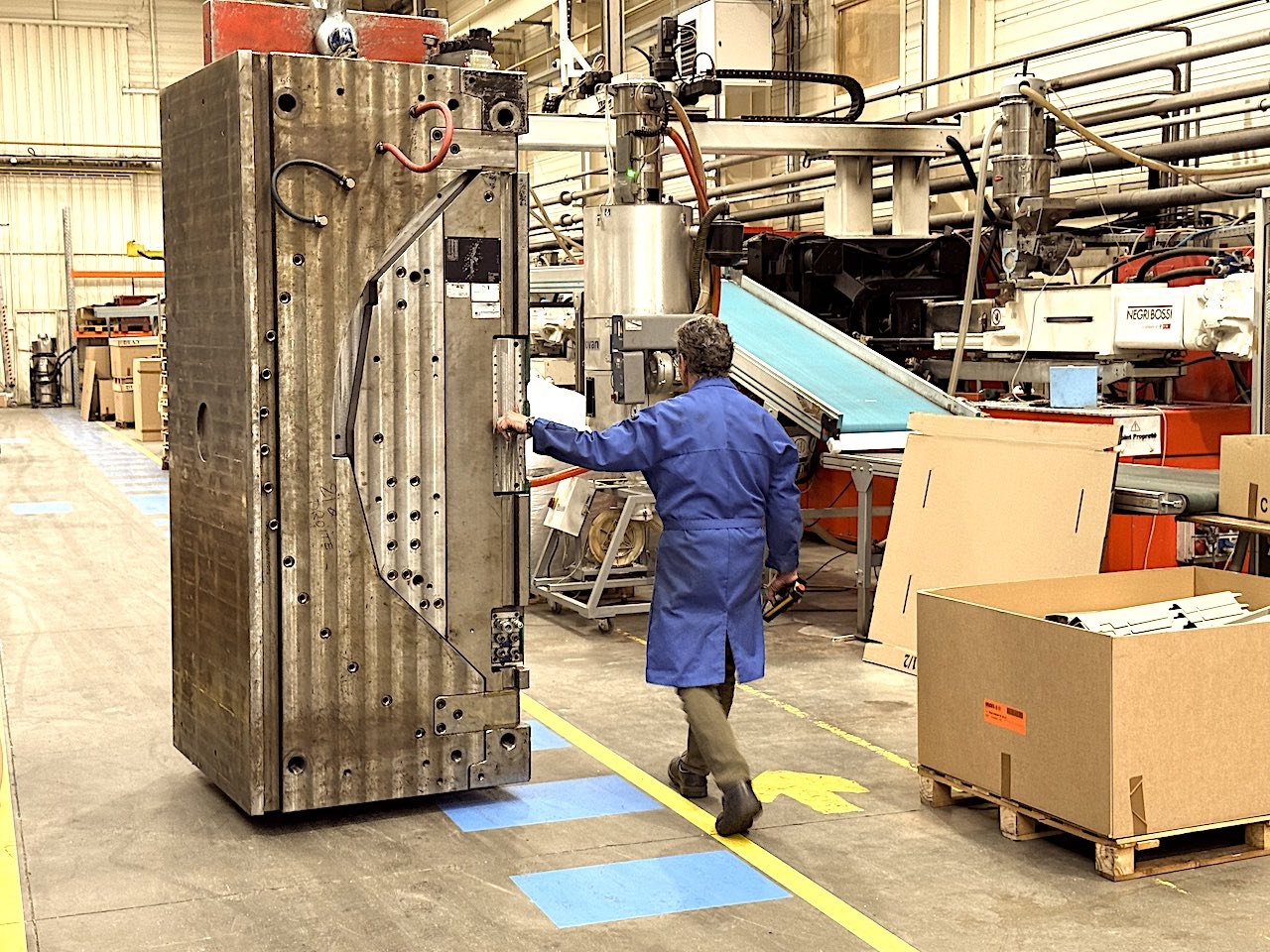
Large parts present their own challenges after the pressing process. EDELTAMP 5,500-square-meter facility is designed to handle these challenges without compromising quality or delivery times.
Post-production storage is managed using specialized materials that prevent creep deformation in the hours following ejection, when the part is still thermally unstable. Scrap and sprues—which account for a significant volume in these molds—are sorted, crushed, and reintroduced in a controlled manner, thereby reducing material costs and ensuring traceability of the recycling process.
The maintenance workshop is equipped to handle heavy machinery: a double-hoist crane for flipping large molds, specialized tools, and trained staff. The lifespan of a mold weighing several tons directly affects the production cost of the entire series. Maintaining it ensures the project’s long-term profitability.
From co-design to delivery, EDELTAMP structures every large-part project so that these specific constraints become drivers of productivity, reliability, and cost control.
Do you have a project involving a large thermoplastic part? Contact our team for a feasibility study.
Other articles in this category
Keep up to date with EDELTAMP and how we're shaping the future of the plastics industry .