Finishing of injection-molded thermoplastic parts
Are you launching a new product? The surface finish of your injection-molded thermoplastic parts is much more than just a matter of aesthetics. It is a strategic factor that directly influences your product’s performance, reliability, and image.
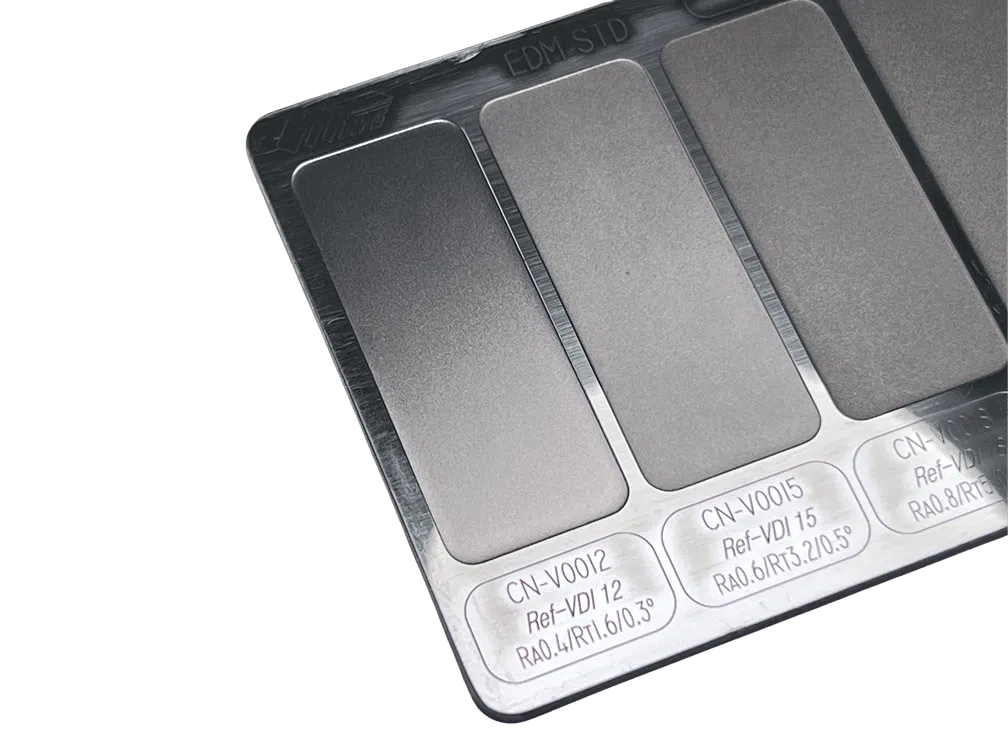
At EDELTAMP, we offer various types of finishes for your thermoplastic parts: smooth and polished surfaces, as well as textured and matte surfaces. Each meets specific performance requirements. The choice depends on your application, your budget, and your functional and aesthetic requirements.
What are we talking about?
Surface roughness refers to the microscopic irregularities present on the surface of a part. It is measured in microns and directly affects:
• visual appearance (gloss, matte),
• the feel of it,
• friction or slippage,
• ease of removal from the mold.
A high roughness value will result in a matte or textured appearance, while a low roughness value will result in a smooth or glossy finish.
Direct impacts on your components in service
There are several reasons to choose specific types of surface finishes. These finishes are valuable because of their ability to conceal injection molding defects, such as weld lines, sink marks, flash marks, and flow lines.
Another advantage of plastic finishes is that they help parts withstand contact damage during shipping or use. This is especially true for textured surface finishes. A textured finish also improves paint adhesion and provides the grip needed to create undercuts.
But beyond these factors, the surface finishes of injection-molded parts enhance the product’s appearance and improve its overall durability.
Glossy or matte finishes: which one should you choose for your project?
The benefits of a smooth, polished surface
Performance and Reduced FrictionA smooth surface reduces friction. Your parts consume less energy, wear out more slowly, and operate more smoothly. This is particularly useful for guides, bearings, or parts that come into contact with water.
Preventing Slipping in Oily EnvironmentsIn oily or wet environments, a smooth surface has a major advantage: oils and greases do not penetrate it. A non-slip surface remains non-slip. Conversely, on a rough surface, grease gradually accumulates in the crevices, making traction unpredictable.
Hygiene and Easy CleaningA polished surface can be cleaned quickly and thoroughly. In medical or food-processing environments, bacteria have nowhere to accumulate. A rough surface, on the other hand, traps contaminants even after vigorous cleaning.
Weather ResistanceA polished part ages better. It is resistant to UV rays, rain, and chemicals. It retains its mechanical properties for a long time. When used outdoors, it easily lasts 5 to 10 years longer than a matte part.
Inconvénients : coûts et adhésion Produire une surface polie coûte cher : polissage mécanique, moule ultra-précis, cycles longs. De plus, les peintures et adhésifs n'accrochent pas bien sur une surface trop lisse. Des traitements supplémentaires (plasma, apprêt chimique) deviennent nécessaires, ce qui augmente délais et coûts.
Even fine scratches become visible and create cosmetic issues.
The benefits of a textured, matte surface
Cost-effective productionA matte finish is much less expensive to produce. No complex polishing, standard molds, short production cycles, and high yields. Ideal for high-volume production and tight budgets.
Excellent adhesion for coatings. Paints, varnishes, and adhesives adhere naturally to textured surfaces. No special treatment is required. Your production line is streamlined and efficient.
Modern and practical design. Matte and satin finishes are in style. This is the contemporary look your customers love. A practical bonus: it hides fingerprints and dust. Less cleaning required.
Better grip and safetyA textured surface provides better grip. Ideal for handles, knobs, and other frequently touched surfaces, especially where there is a risk of slipping. The natural friction enhances safety.
The risks and drawbacks of rough surfaces
Accumulation of contaminantsThe main problem: a rough surface traps dust, grease, food residue, and microorganisms in its crevices. Even after thorough cleaning, these areas remain contaminated.
In the medical or food industries, this poses a health risk and results in tedious maintenance that is never truly effective.
Saftage In oily or wet environments, oily residues gradually seep into the grooves. A non-slip surface can become slippery unexpectedly. This poses a direct safety risk to the user.
Reduced mechanical strengthA rough surface concentrates stress at the micro-peaks. Under repeated loading, these points become crack initiation sites. Your part will break much sooner than an equivalent but polished part.
Faster deterioration outdoorsA rough surface has a larger exposed area, so it deteriorates more quickly when exposed to UV rays, rain, and chemicals. A matte finish will begin to show wear after 5 to 10 years, while a polished finish will still be in excellent condition after 15 to 20 years.
How can you achieve the best possible finish?
It all starts with a detailed specification. What exactly is meant by “smooth surface”? What is the exact degree of roughness? Do all surfaces require the same finish, or just certain areas?
According to the SPI, there are 12 standard types of plastic surface finishes, divided into four categories ranging from smooth to rough (grades A through D).
At EDELTAMP, we classify surfaces into three categories: aesthetic (visible), functional (in contact with other parts), and structural (load-bearing). This classification guides all subsequent decisions.
The mold itself plays a fundamental role in the surface finish of injection-molded parts. For a mirror-polished finish, the cavity undergoes 20 to 40 hours of progressive mechanical polishing. For a standard matte finish, a few hours of sandblasting are sufficient. The mold material also matters: XPM or H13 steel retains the finish better than standard P20 steel.
The choice of materials for injection molding affects the surface finish. Depending on the desired finish (glossy, semi-glossy, matte, or textured), certain plastics (ABS, PP, HDPE, etc.) are better suited for smooth finishes, while others are easier to roughen for a textured finish. In addition, certain additives, such as fillers and colorants, can affect the surface finish of a molded part.
Cooling is the key factor. Poorly controlled mold temperature leads to streaks, irregular shiny spots, and surface defects. We use computer-aided thermal simulation (Moldflow) to predict temperature gradients and identify hot spots. Optimized cooling channels, often made of pure copper for better thermal conductivity, ensure a stable mold temperature.
The polymer temperature, injection speed, pressure, and cycle time must be fine-tuned like an orchestra. Too hot, and the material burns. Too cold, and the part is incomplete. Too fast, and you get turbulence and marks. Too slow, and the surface becomes grainy. It’s a delicate balance that we achieve through successive iterations.
Before starting production, we produce a pilot run of consecutive parts and measure their surface roughness with precision (using a contact roughness tester). Only formal validation ensures long-term compliance.
Optimize your finish, optimize your performance
The return on investment quickly pays off thanks to the extended service life: parts that remain in service 50% longer, fewer defects resulting in fewer customer returns and complaints, improved performance with reduced energy consumption in transmission components, and guaranteed compliance without regulatory or health risks. The surface finish of an injection-molded thermoplastic part is no minor matter. It is a strategic parameter that influences the product’s reliability, safety, durability, and cost.
At EDELTAMP, we put our expertise at your service to specify, design, and optimize each mold according to your actual goals. Not sure what finish your part needs?
Contact our team. Together, we’ll determine the solution that maximizes your project’s performance and cost-effectiveness.
Other articles in this category
Keep up to date with EDELTAMP and how we're shaping the future of the plastics industry .